 Sign in
The latest session in numbersA session is the UTC date a night started, and this is the most recent one any station reported. The network spans time zones, so somewhere is always observing: these are not the numbers for one night everywhere.
session 2026-10-0340 nights of datadump 2026-10-031,707,958 measurements published since 2026-08-23
8,839
measurements
angles, with timing
2
stations reporting
of 10 registered
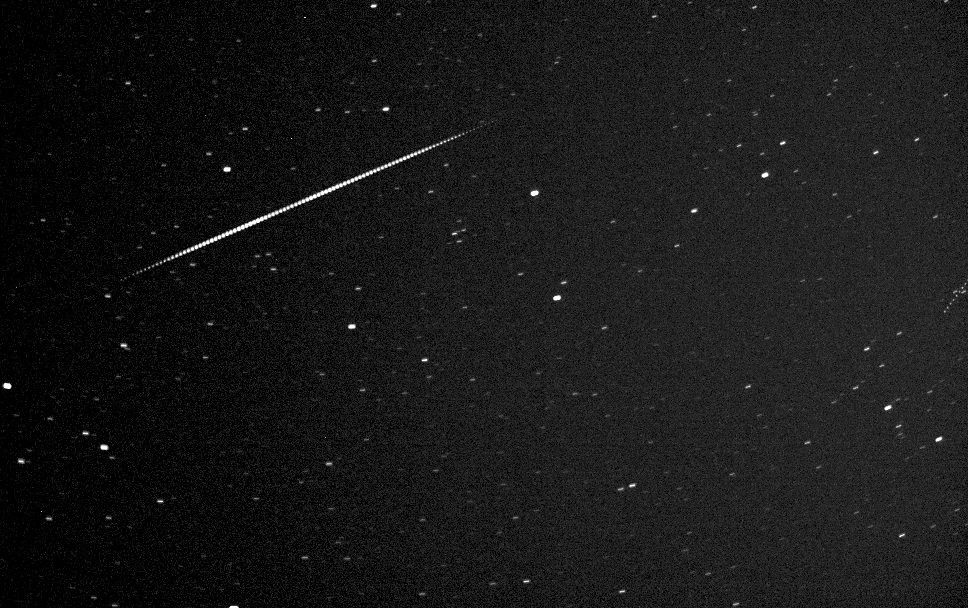
What a track looks likeOne whole frame from a station, uncropped: a stack of 100 sub-exposures of 0.1 s, in which the satellite draws about a pixel per exposure and nothing during the readout between them, leaving a dashed trail against point-like stars. Each dash is one timed sample, and the station uploads a right ascension, a declination and an uncertainty per dash — measurements, not video.
Where the network isEach dot is a €300–500 camera kit on somebody's roof. Amber means the station produced an unknown target in this session.
From the discovery queue
Join the networkA camera, a lens and a Raspberry Pi — €300–500, no licence and no expertise needed. Flash the image, put it under the sky and press Join on the page the station shows you; your measurements are published under your station's name the next morning.
- add this repository to Raspberry Pi Imager — https://librespacefoundation.gitlab.io/satnogs-optical/satnogs-optical-image/rpi-imager.json, then pick “SatNOGS Optical”
- Boot it and open http://satnogs-optical.local — press Join there and sign inThe button opens this site with the station's claim code (OPT-XXXX-XXXX) already filled in; the QR code does the same on your phone. From another device, type the code at optical.satnogs.org/join instead.
- It waits for dark and observes, unattended
Open data, every day
- last dump
- 2026-10-04 04:54Z
- measurements
- 8,839
- formats
- iod · parquet · tdm
- licence
- CC BY-SA 4.0
optical.satnogs.org/api/v1/dumps/2026-10-03